> ## Documentation Index
> Fetch the complete documentation index at: https://docs.cnap.tech/llms.txt
> Use this file to discover all available pages before exploring further.
# $1M Cloud Product
> Complete journey from idea to revenue: turn your software into a profitable business with CNAP
 ## Objectives
By the end of this tutorial, you will:
* Understand what makes cloud-native products successful
* Learn the fastest path from code to paying customers
* Know how to package, price, and sell your software
* Have a clear strategy for building a profitable cloud product
The information provided here is for educational purposes. While the strategies and concepts discussed are aimed at helping you achieve success and are based on real-world examples, there is no guarantee of specific outcomes. Success depends on various factors including individual effort, market conditions, and technical execution. **BUILDING A SUCCESSFUL PRODUCT REQUIRES HARD WORK AND PERSISTENCE.**
## Prerequisites
* Basic understanding of software development
* A software application or idea you want to monetize
* CNAP account (sign up at [cnap.tech](https://cnap.tech))
* GitHub repository with your code (optional, but recommended)
## Understanding Cloud-Native Products
A cloud-native product is a software application built using modern containerized architecture that's designed to run efficiently in cloud environments.
But here's the reality: **your customers don't care if your product is "cloud-native" or not**. They care about the value it provides.
Anyone building software products today should leverage cloud-native approaches, but many get stuck in the infrastructure weeds and never ship. Why? Because becoming an expert in Kubernetes, cloud infrastructures, CI/CD pipelines, multi-tenancy, and security is time-consuming and complex.
This is exactly why CNAP exists—to handle the complex cloud-native infrastructure so you can focus on building features your customers will pay for.
If you don't use a platform like CNAP, you risk spending months setting up infrastructure instead of shipping features that create revenue—and that's how most software products fail before they even start.
## What Successful Cloud-Native Products Have in Common
Research shows that most successful cloud products share these characteristics:
This is the number one factor across all successful cloud products, especially for early-stage startups and indie developers.
They all spend their time in one (or many) of the following areas:
1. **Understanding customer pain points** - Talking to users and really understanding their problems
2. **Building differentiated features** - Creating solutions that stand out from alternatives
3. **Getting early feedback** - Shipping quickly to validate ideas before investing too much time
For example:
* Understanding pain points: Creating a solution that directly addresses a specific workflow bottleneck for target users
* Building differentiated features: Adding unique capabilities that existing products can't easily copy
* Getting early feedback: Releasing an MVP in weeks, not months, to start the learning cycle
The most successful products aren't built by teams that create everything from scratch. Often, these founders stand on the shoulders of giants, using platforms that already solved the hard infrastructure problems.
Sometimes, these platforms handle everything from deployment to scaling to security, allowing the founders to focus entirely on their unique value.
For example:
* Kubernetes (adopted by 96% of organizations in 2023)
* CI/CD automation (used by 83% of software teams)
* Cloud hosting (powering millions of applications)
10 paying customers × $100/month = $1,000 MRR → \$12K ARR → YOUR FIRST MICRO-SAAS
Then scale to 100 customers = $10K MRR → $120K ARR → LIFE-CHANGING INCOME
Successful cloud-native products start with a "pointy" solution—a focused product that solves a specific problem extremely well. In other words, they generally start by doing one thing better than anyone else.
Nearly all successful products researched started this way. Instead of building a comprehensive platform, they start with:
* One critical workflow that's painful for users
* One integration that solves a specific pain point
* One dashboard that provides unique insights
In nearly all examples, successful cloud-native products serve a very specific customer.
Here's one example:
1. Healthcare organizations (too broad)
2. Healthcare clinics (still broad)
3. Healthcare clinics using electronic health records (getting specific)
4. Healthcare clinics using electronic health records who need HIPAA-compliant (US) or GDPR-compliant (EU) patient portals with appointment scheduling and secure messaging (highly specific)
**Concrete example**: A customer portal platform for B2B SaaS companies. This targets SaaS businesses selling to enterprise clients who need to provide their customers with a branded portal for managing accounts, viewing invoices, submitting support tickets, and accessing documentation.
More examples:
* Node.js developers building microservices who need managed API gateways with rate limiting and authentication
* Python data science teams who need managed Jupyter notebook environments with GPU support and shared datasets
* Dev teams using GitHub who need to streamline their release process
* Mobile app developers who need backend-as-a-service with user authentication, file storage, and real-time sync
* Marketing agencies managing 20+ client WordPress websites who need centralized updates, backups, and security monitoring
* Financial services companies requiring PCI DSS and SOC 2 (US) or GDPR, DORA, and MiFID II (EU) compliance who need dedicated deployments with data residency controls
All successful products are rooted in solving painful problems. And all painful business problems relate back to two core issues:
* "We're losing money or missing opportunities."
* "We're wasting time on tedious tasks."
This guide breaks down specific problems that cloud-native products can solve, but remember that all successful products ultimately address one of these two core issues. Always analyze your product idea through this lens.
## Additional Success Factors
* **B2B focus** - Products targeting businesses typically generate more revenue with fewer customers than B2C products
* **Price based on value** - Most successful cloud-native products charge at least \$50-100/month for their base plans, with enterprise tiers reaching thousands per month
* **Consider how you'll market** - Many successful founders build audiences through content marketing, open-source, or community engagement before launching their paid products
## How CNAP Helps You Build a Profitable Cloud-Native Product
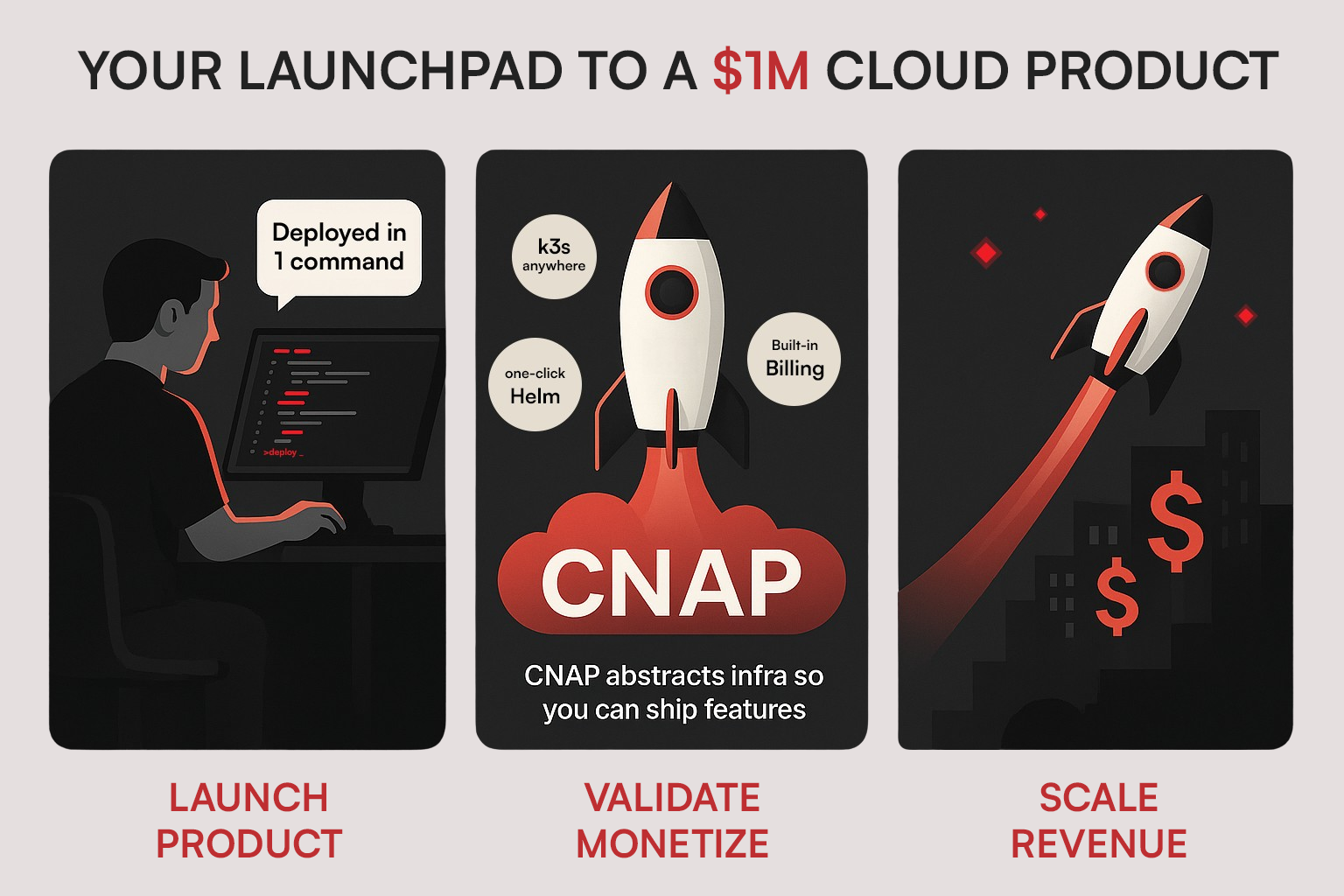
CNAP (Cloud Native Application Platform) is specifically designed to help developers turn code into a profitable business with minimal overhead:
CNAP handles the underlying infrastructure, deployment pipeline, and operational complexities.
Deploy your app in minutes rather than spending weeks setting up Kubernetes clusters, CI/CD pipelines, and monitoring.
CNAP includes the tools to package, price, and sell your software directly to customers.
Let customers see exactly what they're paying for with clear resource allocation and costs.
As your customer base grows, CNAP handles the increasing infrastructure demands automatically.
## The Path to Your First Profitable Cloud Product
Follow these steps to go from code to paying customers:
Create a cluster to host your product deployments. CNAP's KaaS manages the control plane and Kubernetes operations, while you add workers to provide compute capacity.
You can create a managed cluster or import an existing Kubernetes cluster. For most products, a managed cluster is the fastest path to production.
[Create a cluster →](/clusters/create)
Create a product from your application sources. CNAP automatically creates a template from your Helm sources and generates a versioned package.
You can deploy from GitHub repositories (automatic builds with Railpack), Helm charts from Artifact Hub, or Docker images. CNAP handles containerization, packaging, and version management automatically.
[Create a product →](/products) | [Application sources →](/app-sources)
Connect your Stripe account and add pricing to your product. Products with Stripe pricing automatically appear in the marketplace.
CNAP uses Stripe Connect for marketplace payments. Configure subscription or one-time pricing, and CNAP handles customer management, billing, and payment processing automatically.
[Set up payments →](/payments)
Products with Stripe pricing automatically appear in the marketplace. Customers can discover, purchase, and deploy your product with automatic deployment to your clusters.
You can also sell outside the marketplace by sharing direct links to your product's deployment page. Each customer purchase triggers an automatic deployment to your cluster with complete isolation.
[Marketplace →](/marketplace)
Update your product sources to push new versions. CNAP automatically generates new packages and can deploy updates to existing customer installations.
Monitor deployments through the dashboard and gather customer feedback. As your customer base grows, CNAP handles the increasing infrastructure demands automatically.
## Real-World Success Stories
While specific examples could be shared, what matters most is that developers are using platforms like CNAP to bypass the complexities of cloud infrastructure and focus on building products that customers love and pay for.
The key is to start small, focus on a specific problem, and leverage platforms that handle the infrastructure complexity for you.
The goal of this guide is to help you understand how to transform your code into a profitable cloud-native product without getting bogged down in infrastructure details—now go build and sell your software!
### Lando.health: Scaling Healthcare Software with CNAP
Lando.health provides healthcare management software to hospitals and clinics across Germany. Their platform includes a content management system for hospital administrators and a point-of-care application for doctors—serving hospitals, clinics, and universities with strict GDPR compliance and data residency requirements.
**The Challenge:**
Before adopting CNAP, Lando.health managed deployments manually. Each customer deployment required:
* Manual Docker container setup for every hospital
* Custom configuration per customer (subdomains, environment variables, databases)
* Hours of manual work per deployment
* No reproducibility—each customer was a custom build
* Limited scalability as their customer base grew
With healthcare compliance requirements and the need to deploy to customer-owned infrastructure (including on-premises data centers), they needed a solution that could handle strict isolation, data residency, and reproducible deployments while allowing them to adopt external infrastructure into their product delivery pipeline. Deploying to hospitals' server environments adds even more complexity—each hospital may have different infrastructure, security policies, and network configurations. CNAP provides the structure, automation, and remote control needed to streamline these deployments across diverse hospital environments.
**How CNAP Solved It:**
CNAP enabled Lando.health to transform their deployment process:
* **Reproducible deployments** - Every customer gets the same standardized setup, deployed in minutes instead of hours
* **Compliance-ready isolation** - Per-customer isolated Kubernetes clusters ensure complete data separation for GDPR compliance
* **Flexible infrastructure** - Deploy to Lando-managed clusters, customer cloud accounts, or on-premises data centers
* **Enterprise-grade automation** - Industry-standard reliability with automated workflows from Docker Compose to production deployment in under 5 minutes, powered by platform capabilities
**The Impact:**
Lando.health can now scale their healthcare platform efficiently while maintaining the strict compliance requirements their hospital customers demand. They maintain control and cost control of their infrastructure without the operational overhead—owning infrastructure components without needing to manage deployments, rebalancing, and failover manually. The time savings and operational efficiency allow them to focus on building features that improve patient care rather than managing infrastructure complexity.
Lando.health's adoption demonstrates CNAP's strength in the most challenging sector—healthcare. While many platforms shy away from highly regulated environments, CNAP embraces them because it was architected from the ground up to support both simple deployments and highly regulated environments with strict compliance requirements, data isolation, and auditability.
## Related Topics
* [Quickstart →](/quickstart) - Get your first product live in 10 minutes
* [Create a product →](/products) - Package your software for sale
* [Marketplace →](/marketplace) - Understand how products are sold
* [Set up payments →](/payments) - Configure Stripe for product billing
* [Learn about workspaces →](/workspaces) - Understand workspace organization
## Objectives
By the end of this tutorial, you will:
* Understand what makes cloud-native products successful
* Learn the fastest path from code to paying customers
* Know how to package, price, and sell your software
* Have a clear strategy for building a profitable cloud product
The information provided here is for educational purposes. While the strategies and concepts discussed are aimed at helping you achieve success and are based on real-world examples, there is no guarantee of specific outcomes. Success depends on various factors including individual effort, market conditions, and technical execution. **BUILDING A SUCCESSFUL PRODUCT REQUIRES HARD WORK AND PERSISTENCE.**
## Prerequisites
* Basic understanding of software development
* A software application or idea you want to monetize
* CNAP account (sign up at [cnap.tech](https://cnap.tech))
* GitHub repository with your code (optional, but recommended)
## Understanding Cloud-Native Products
A cloud-native product is a software application built using modern containerized architecture that's designed to run efficiently in cloud environments.
But here's the reality: **your customers don't care if your product is "cloud-native" or not**. They care about the value it provides.
Anyone building software products today should leverage cloud-native approaches, but many get stuck in the infrastructure weeds and never ship. Why? Because becoming an expert in Kubernetes, cloud infrastructures, CI/CD pipelines, multi-tenancy, and security is time-consuming and complex.
This is exactly why CNAP exists—to handle the complex cloud-native infrastructure so you can focus on building features your customers will pay for.
If you don't use a platform like CNAP, you risk spending months setting up infrastructure instead of shipping features that create revenue—and that's how most software products fail before they even start.
## What Successful Cloud-Native Products Have in Common
Research shows that most successful cloud products share these characteristics:
This is the number one factor across all successful cloud products, especially for early-stage startups and indie developers.
They all spend their time in one (or many) of the following areas:
1. **Understanding customer pain points** - Talking to users and really understanding their problems
2. **Building differentiated features** - Creating solutions that stand out from alternatives
3. **Getting early feedback** - Shipping quickly to validate ideas before investing too much time
For example:
* Understanding pain points: Creating a solution that directly addresses a specific workflow bottleneck for target users
* Building differentiated features: Adding unique capabilities that existing products can't easily copy
* Getting early feedback: Releasing an MVP in weeks, not months, to start the learning cycle
The most successful products aren't built by teams that create everything from scratch. Often, these founders stand on the shoulders of giants, using platforms that already solved the hard infrastructure problems.
Sometimes, these platforms handle everything from deployment to scaling to security, allowing the founders to focus entirely on their unique value.
For example:
* Kubernetes (adopted by 96% of organizations in 2023)
* CI/CD automation (used by 83% of software teams)
* Cloud hosting (powering millions of applications)
10 paying customers × $100/month = $1,000 MRR → \$12K ARR → YOUR FIRST MICRO-SAAS
Then scale to 100 customers = $10K MRR → $120K ARR → LIFE-CHANGING INCOME
Successful cloud-native products start with a "pointy" solution—a focused product that solves a specific problem extremely well. In other words, they generally start by doing one thing better than anyone else.
Nearly all successful products researched started this way. Instead of building a comprehensive platform, they start with:
* One critical workflow that's painful for users
* One integration that solves a specific pain point
* One dashboard that provides unique insights
In nearly all examples, successful cloud-native products serve a very specific customer.
Here's one example:
1. Healthcare organizations (too broad)
2. Healthcare clinics (still broad)
3. Healthcare clinics using electronic health records (getting specific)
4. Healthcare clinics using electronic health records who need HIPAA-compliant (US) or GDPR-compliant (EU) patient portals with appointment scheduling and secure messaging (highly specific)
**Concrete example**: A customer portal platform for B2B SaaS companies. This targets SaaS businesses selling to enterprise clients who need to provide their customers with a branded portal for managing accounts, viewing invoices, submitting support tickets, and accessing documentation.
More examples:
* Node.js developers building microservices who need managed API gateways with rate limiting and authentication
* Python data science teams who need managed Jupyter notebook environments with GPU support and shared datasets
* Dev teams using GitHub who need to streamline their release process
* Mobile app developers who need backend-as-a-service with user authentication, file storage, and real-time sync
* Marketing agencies managing 20+ client WordPress websites who need centralized updates, backups, and security monitoring
* Financial services companies requiring PCI DSS and SOC 2 (US) or GDPR, DORA, and MiFID II (EU) compliance who need dedicated deployments with data residency controls
All successful products are rooted in solving painful problems. And all painful business problems relate back to two core issues:
* "We're losing money or missing opportunities."
* "We're wasting time on tedious tasks."
This guide breaks down specific problems that cloud-native products can solve, but remember that all successful products ultimately address one of these two core issues. Always analyze your product idea through this lens.
## Additional Success Factors
* **B2B focus** - Products targeting businesses typically generate more revenue with fewer customers than B2C products
* **Price based on value** - Most successful cloud-native products charge at least \$50-100/month for their base plans, with enterprise tiers reaching thousands per month
* **Consider how you'll market** - Many successful founders build audiences through content marketing, open-source, or community engagement before launching their paid products
## How CNAP Helps You Build a Profitable Cloud-Native Product
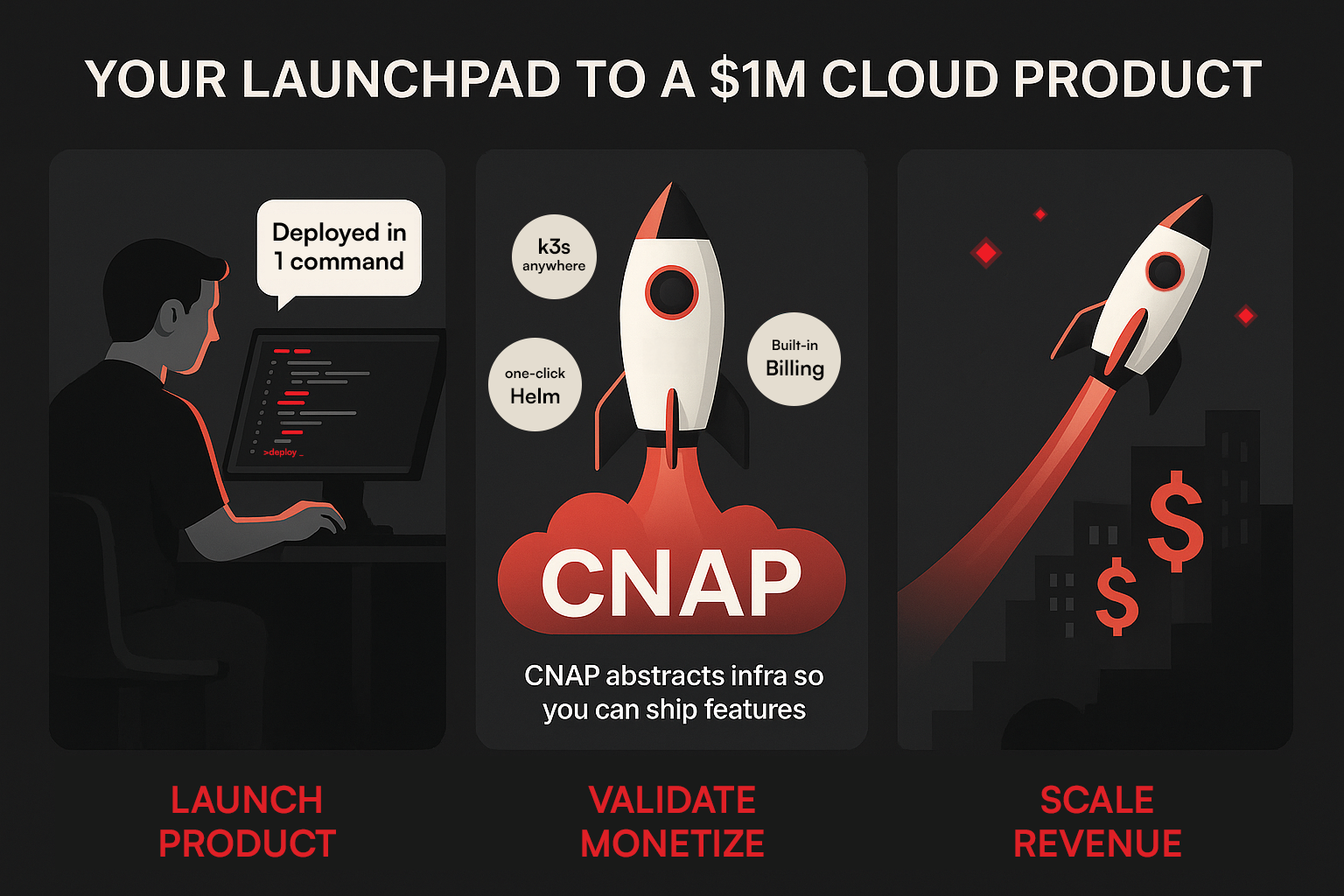
CNAP (Cloud Native Application Platform) is specifically designed to help developers turn code into a profitable business with minimal overhead:
CNAP handles the underlying infrastructure, deployment pipeline, and operational complexities.
Deploy your app in minutes rather than spending weeks setting up Kubernetes clusters, CI/CD pipelines, and monitoring.
CNAP includes the tools to package, price, and sell your software directly to customers.
Let customers see exactly what they're paying for with clear resource allocation and costs.
As your customer base grows, CNAP handles the increasing infrastructure demands automatically.
## The Path to Your First Profitable Cloud Product
Follow these steps to go from code to paying customers:
Create a cluster to host your product deployments. CNAP's KaaS manages the control plane and Kubernetes operations, while you add workers to provide compute capacity.
You can create a managed cluster or import an existing Kubernetes cluster. For most products, a managed cluster is the fastest path to production.
[Create a cluster →](/clusters/create)
Create a product from your application sources. CNAP automatically creates a template from your Helm sources and generates a versioned package.
You can deploy from GitHub repositories (automatic builds with Railpack), Helm charts from Artifact Hub, or Docker images. CNAP handles containerization, packaging, and version management automatically.
[Create a product →](/products) | [Application sources →](/app-sources)
Connect your Stripe account and add pricing to your product. Products with Stripe pricing automatically appear in the marketplace.
CNAP uses Stripe Connect for marketplace payments. Configure subscription or one-time pricing, and CNAP handles customer management, billing, and payment processing automatically.
[Set up payments →](/payments)
Products with Stripe pricing automatically appear in the marketplace. Customers can discover, purchase, and deploy your product with automatic deployment to your clusters.
You can also sell outside the marketplace by sharing direct links to your product's deployment page. Each customer purchase triggers an automatic deployment to your cluster with complete isolation.
[Marketplace →](/marketplace)
Update your product sources to push new versions. CNAP automatically generates new packages and can deploy updates to existing customer installations.
Monitor deployments through the dashboard and gather customer feedback. As your customer base grows, CNAP handles the increasing infrastructure demands automatically.
## Real-World Success Stories
While specific examples could be shared, what matters most is that developers are using platforms like CNAP to bypass the complexities of cloud infrastructure and focus on building products that customers love and pay for.
The key is to start small, focus on a specific problem, and leverage platforms that handle the infrastructure complexity for you.
The goal of this guide is to help you understand how to transform your code into a profitable cloud-native product without getting bogged down in infrastructure details—now go build and sell your software!
### Lando.health: Scaling Healthcare Software with CNAP
Lando.health provides healthcare management software to hospitals and clinics across Germany. Their platform includes a content management system for hospital administrators and a point-of-care application for doctors—serving hospitals, clinics, and universities with strict GDPR compliance and data residency requirements.
**The Challenge:**
Before adopting CNAP, Lando.health managed deployments manually. Each customer deployment required:
* Manual Docker container setup for every hospital
* Custom configuration per customer (subdomains, environment variables, databases)
* Hours of manual work per deployment
* No reproducibility—each customer was a custom build
* Limited scalability as their customer base grew
With healthcare compliance requirements and the need to deploy to customer-owned infrastructure (including on-premises data centers), they needed a solution that could handle strict isolation, data residency, and reproducible deployments while allowing them to adopt external infrastructure into their product delivery pipeline. Deploying to hospitals' server environments adds even more complexity—each hospital may have different infrastructure, security policies, and network configurations. CNAP provides the structure, automation, and remote control needed to streamline these deployments across diverse hospital environments.
**How CNAP Solved It:**
CNAP enabled Lando.health to transform their deployment process:
* **Reproducible deployments** - Every customer gets the same standardized setup, deployed in minutes instead of hours
* **Compliance-ready isolation** - Per-customer isolated Kubernetes clusters ensure complete data separation for GDPR compliance
* **Flexible infrastructure** - Deploy to Lando-managed clusters, customer cloud accounts, or on-premises data centers
* **Enterprise-grade automation** - Industry-standard reliability with automated workflows from Docker Compose to production deployment in under 5 minutes, powered by platform capabilities
**The Impact:**
Lando.health can now scale their healthcare platform efficiently while maintaining the strict compliance requirements their hospital customers demand. They maintain control and cost control of their infrastructure without the operational overhead—owning infrastructure components without needing to manage deployments, rebalancing, and failover manually. The time savings and operational efficiency allow them to focus on building features that improve patient care rather than managing infrastructure complexity.
Lando.health's adoption demonstrates CNAP's strength in the most challenging sector—healthcare. While many platforms shy away from highly regulated environments, CNAP embraces them because it was architected from the ground up to support both simple deployments and highly regulated environments with strict compliance requirements, data isolation, and auditability.
## Related Topics
* [Quickstart →](/quickstart) - Get your first product live in 10 minutes
* [Create a product →](/products) - Package your software for sale
* [Marketplace →](/marketplace) - Understand how products are sold
* [Set up payments →](/payments) - Configure Stripe for product billing
* [Learn about workspaces →](/workspaces) - Understand workspace organization